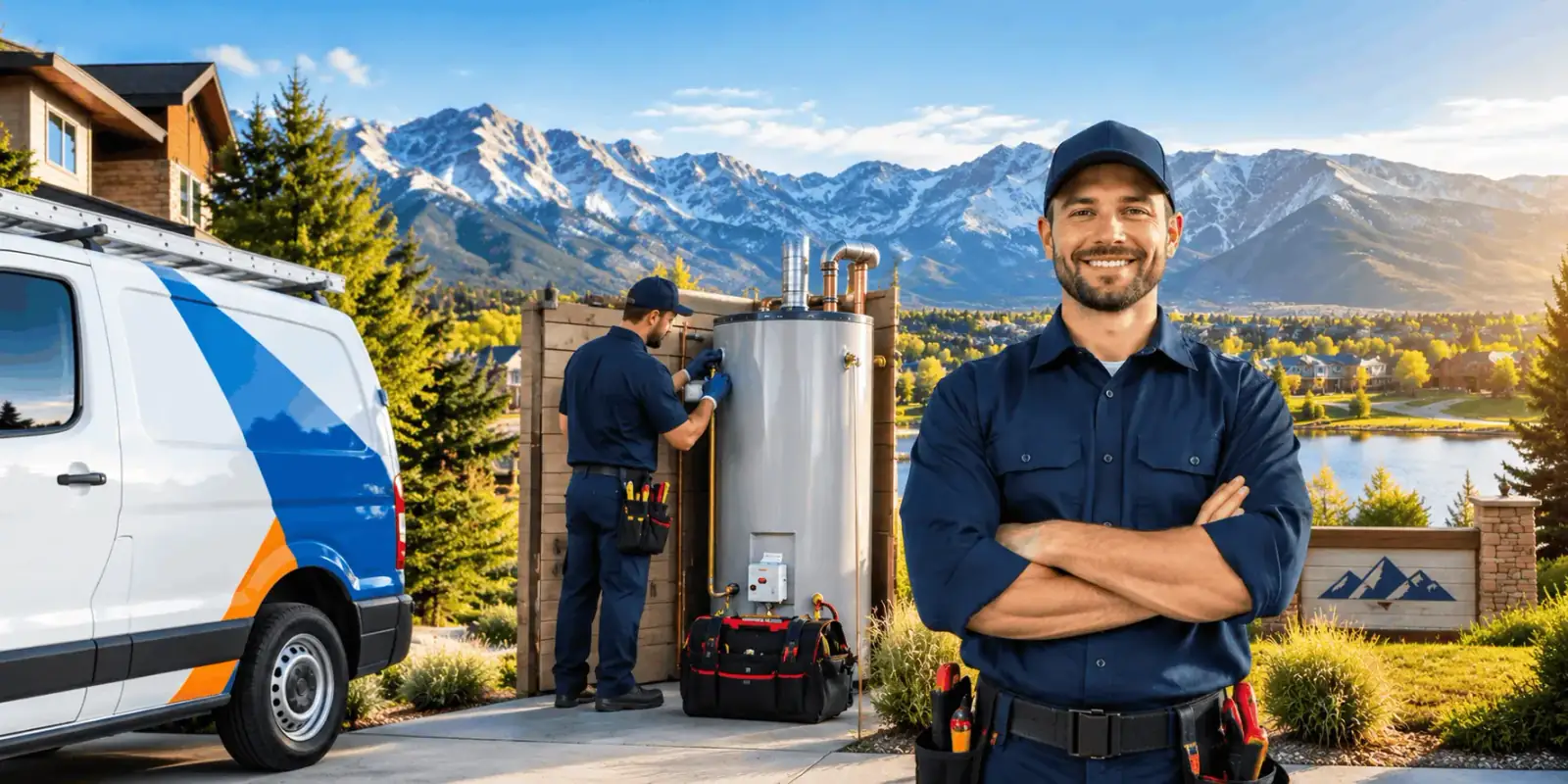
Water Heater Installation in Littleton, CO
Installing a new water heater in Littleton, CO involves safe fuel or electrical and venting connections, setting the unit, leak checks, and any required permits and inspections. Littleton Water Heater Pros performs the work in-house. To confirm the details for your home, see contact us to discuss your installation needs.
Last reviewed .
How does a new water heater installation work?
Tell Us What the Install Is For
New construction, an added unit for a finished basement or rental, or a planned upgrade from an aging tank — the scope decides everything that follows.
Sizing & Site Assessment
We work out household demand, then check fuel supply, venting route, electrical capacity, and how a full cylinder reaches the location you have in mind.
Written Quote & Permit
One written price covering the unit, labour, any new gas, electrical or venting runs, and the permit — nothing is ordered until you approve it.
Install Day & Inspection
The unit is set, connected, vented, filled and leak-tested, then the county inspection is booked and we walk you through the controls before we leave.
What Should Be Settled Before Installation Day?
A new installation goes wrong when a decision is left until the unit is already in the room — the wrong capacity, a vent route with nowhere to go, a gas line that cannot carry the burner. We settle sizing, fuel, venting, and the permit in writing before anything is ordered. Here is what that looks like next to the questions worth asking any company you are considering, including us.
Our Littleton Company
- The technician who arrives works for us, and we quote the repair in writing before starting.
- One company is accountable for the diagnosis, the repair, and any follow-up.
- Parts are matched to your unit's manufacturer specification rather than a generic substitute.
- Repairs that touch gas, venting, or pressure relief are tested before we leave.
- You can call the same local office back and reach someone who knows your job.
Questions to Ask Any Company
- ✕Who exactly is turning up, and do they work for the company you called?
- ✕Will you give me the price in writing before the work starts, or only after?
- ✕Are the parts matched to my unit's specification, or generic equivalents?
- ✕Who do I call if something needs putting right afterwards?
- ✕Is the person doing gas or venting work qualified to test it before leaving?
What does water heater installation in Littleton involve?
Installation is new equipment going in, rather than a failed tank coming out. That covers a first unit in new construction, a second unit for a finished basement, an in-law suite or a rental, and a planned upgrade where an aging tank is being retired before it fails. It is a different job from a swap, because nothing can be assumed to be reusable. Start from our Littleton water heater services if you are still deciding what your home actually needs, then work through what the visit involves.
- Sizing and selection — household demand, fuel type, and capacity, decided before any equipment is ordered.
- Permit — new installations are permitted work, and the permit is what triggers the inspection.
- Safe isolation — water, gas or power shut off at the source and the location checked before work begins.
- Setting the unit — positioned with the clearance, drain pan, and expansion control the code requires for the space.
- Connections — water, fuel or electrical, sized to the unit rather than reused from whatever was there before.
- Venting — flue or sidewall vent run to the route the fuel and elevation allow.
- Fill and leak test — the tank is filled, air purged, and every joint checked before the job is called finished.
- Inspection and walkthrough — the county inspection is booked, and we show you the shutoff, thermostat, and drain valve.
One thing worth saying plainly: not every problem needs new equipment. If your existing unit is faulting rather than being replaced by choice, it is worth finding out whether it is still fixable before you commit to an install — our water heater repair page covers which component failures are worth repairing.
Tank vs tankless: which makes sense at install time?
This is the one decision that is genuinely easier to make during a new installation than at any other time, because the venting, gas line, and electrical work can be planned around the unit instead of retrofitted to it. The short version of the tradeoff:
| Consideration | Tank (gas or electric) | Tankless |
|---|---|---|
| Space in the mechanical room | Needs a footprint for the cylinder plus clearance around it. | Wall-mounted, so it frees the floor — but needs a venting and condensate route. |
| How hot water is supplied | Stores a set volume and recovers between draws. | Heats on demand, so supply follows flow rate rather than stored capacity. |
| Venting | Atmospheric or power-vent flue, sized for the fuel and the elevation. | Concentric PVC or stainless vent, often a longer or sidewall route. |
| Gas and electrical supply | An existing line is often reusable on a like-for-like install. | Usually needs a larger gas line and a dedicated circuit. |
| Where it tends to fit | Most Littleton homes, particularly where an existing location is being reused. | Households with steady demand and a mechanical space that cannot take a cylinder. |
If tankless is the direction you are leaning, the full detail on sizing a unit to your flow demand, venting routes, and gas line requirements is on our tankless water heater page. If you already have a tank and are weighing the switch as part of retiring it, that decision belongs with water heater replacement options, which covers conversion-at-replacement. Either way, the assessment is the same visit.
What size water heater do I need?
Capacity follows demand, not floor area. The questions that actually decide it are how many people are in the house, how many hot-water appliances can run at once, and how the household uses water — two showers back to back is a different load from one shower an hour apart. For a first unit in new construction we size from the fixture count; for an added unit we size from what the new space will draw on its own.
Recovery rate matters as much as the label on the tank, and for gas units the existing supply line and vent have to be able to carry the burner you choose. At Littleton's elevation every gas burner has to be set for the air it actually gets, which is a commissioning detail, not an afterthought. Sizing is part of the recommendation we make on site rather than a number you pick off a chart — contact us with your household details and we will talk through what fits.
What affects the cost to install a water heater?
There is no published rate card here, because a unit dropped in where the gas line, circuit, and vent already exist is a different job from one where all three have to be created. What we can tell you is exactly what moves the number on your quote:
| Cost Factor | Why It Changes the Price |
|---|---|
| Running or upsizing a gas line | A unit with a larger burner may need a bigger supply line, and that is pipe work rather than a connection. |
| Adding a dedicated circuit | An electric tank needs its own circuit and breaker sized to the element load. |
| New venting route | A first-time install, or one in a new location, means a new flue or sidewall vent run through the building. |
| Permit and inspection | New installations are permitted work, and the inspection is booked as part of the schedule. |
| Access and handling | Getting a full cylinder into a basement, a crawlspace, or an upstairs closet changes the labour involved. |
| Code items for the space | Expansion control, a drain pan, and a properly routed relief valve are often required where none existed before. |
| Removing an existing unit | Where an old unit comes out, draining and haul-away are part of the job, not an extra. |
| Equipment selection | Capacity, fuel type, and tank against tankless are different equipment at different price points. |
Each of those lines is itemised on your quote and approved by you before anything is ordered. If what you are actually weighing is whether to repair the unit you already have, note that repair cost is a separate question with its own factors — our guide to repair cost factors in Littleton covers that side of it, and nothing in it applies to pricing a new installation.
Permits, Code & Colorado Venting Considerations
A new installation is permitted work, and the permit scope follows the job rather than the equipment. Replacing a tank in the same spot with the same fuel is a narrower permit than putting a unit where none has been, moving one to a new location, or changing fuel type — because each of those adds venting, gas, or electrical work that an inspector will want to see. Littleton addresses fall across more than one county building department, so which jurisdiction issues the permit depends on your address.
What gets checked is set by plumbing and mechanical code, not by us: venting sized for the fuel and the elevation, sound gas or electrical connections, a relief valve piped to a safe discharge point, and expansion control on the cold side where the supply is closed. On work we perform, the permit application and the inspection booking are handled by our office and carried on the quote.
Elevation is the Colorado-specific part. At Littleton's altitude a gas appliance has to be set up for the air density it actually operates in, and venting runs have to be sized for the installation rather than copied from a spec sheet written at sea level. We treat that as part of commissioning. Coverage questions, including which county your address falls in, are on our South Metro Denver service areas page.
How long does a water heater installation take?
A straightforward tank installation where the location, gas line, circuit, and vent already exist is typically a single visit. What extends it is new work rather than the unit itself: running a gas line, adding a circuit, cutting a new vent route through a roof or wall, or getting a cylinder into a space with awkward access. We flag anything that will affect the schedule in the quote, before you book, rather than on the day.
If your situation is not a planned installation at all — no hot water right now, or water where it should not be — say so when you call. Our urgent water heater issues line handles the immediate problem, and an installation can be scoped afterwards once the property is safe.
When is a repair the better answer than a new installation?
If a single component has failed and the tank itself is sound, repair is usually the right call — a new installation is not a way to solve a faulty thermocouple. The decision framework that matters is age against condition, repair scope against new equipment, and what you get back in efficiency if you do go new. We do not re-answer that here because the tradeoff deserves its own space: our unbiased repair vs replace guide walks through it properly.
Which Littleton and South Metro areas do you install in?
We install water heaters across Littleton and the surrounding South Metro communities, including Highlands Ranch, Downtown Littleton, Centennial, Columbine, and Ken Caryl. Which county your address sits in decides the permit, so it is worth checking the service areas page or asking the office directly through contact before you assume anything about the paperwork.
Available in Your Neighborhood
How We Work on Every Job
A Written Price Before We Start
You get the diagnosis and a fixed quote in writing. If the price changes, it is because you approved a change — never a surprise line on the invoice.
Our Own Technicians, Not Subcontractors
The person who arrives works for us. One company is accountable for the diagnosis, the repair, and the follow-up if anything needs putting right.
Parts to Manufacturer Specification
We fit components matched to your unit rather than a generic substitute that happens to fit.
Water Heater Installation Questions, Answered
Sizing a first unit, adding a second one, venting and permits in Littleton, and what install day actually looks like — the questions homeowners ask us before a new installation goes ahead.
Have a question we have not covered?
Tell our office what the installation is for — new build, added unit, or an upgrade — and we will explain what it involves for your address.
What does water heater installation in Littleton involve?
Sizing the unit to your household, pulling the permit, safely isolating water and fuel or power, setting the unit with the clearance and safety devices code requires, connecting and venting it, then filling and leak-testing every joint. The county inspection is booked as part of the job.
Do I need a permit to install a new water heater in Colorado?
How long does a water heater installation take?
What size water heater do I need?
What affects the cost to install a water heater?
Should I get a tank or tankless water heater?
Can I install my own water heater?
What types of water heaters do you install?
What should I expect on installation day?
Related Heating & Plumbing Solutions
Planning a New Water Heater?
Our own team installs tank and tankless water heaters across Littleton and South Metro Denver — sizing, any new gas, electrical or venting work, and the permit priced in writing before we start.